
Best Treatment in Cervical Spondylosis

Cervical spondylosis is a common degenerative condition of the cervical spine (neck region). It occurs due to age-related wear and tear affecting the cervical vertebrae, intervertebral discs, joints, and ligaments. With increasing age, the structures of the neck gradually degenerate, leading to pain, stiffness, and sometimes neurological symptoms. Cervical spondylosis is also known as cervical osteoarthritis or degenerative cervical spine disease.
It is very common in people above the age of 40 years, but due to poor posture, prolonged mobile and computer use, stress, and sedentary lifestyle, it is now increasingly seen in younger individuals as well.
Anatomy of Cervical Spine
The cervical spine consists of 7 vertebrae (C1–C7). Between each vertebra lies an intervertebral disc, which acts as a shock absorber and allows movement. The cervical spine supports the head, protects the spinal cord, and allows movements such as flexion, extension, rotation, and side bending.
Important structures involved:
- Cervical vertebrae
- Intervertebral discs
- Facet joints
- Ligaments
- Muscles
- Nerve roots and spinal cord
Degeneration of any of these structures can lead to cervical spondylosis.
Causes of Cervical Spondylosis
Cervical spondylosis develops mainly due to degenerative changes, but several factors contribute to its development:
- Age-related degeneration – discs lose water content and elasticity.
- Poor posture – prolonged forward head posture while using mobiles or computers.
- Disc dehydration and shrinkage – leading to reduced disc height.
- Osteophyte (bone spur) formation – body tries to stabilize the spine.
- Ligament thickening – reduces space for nerves.
- Repetitive neck strain – due to occupational work.
- Trauma or injury – previous neck injuries increase risk.
- Sedentary lifestyle – weak neck and upper back muscles.
- Stress and muscle tension – chronic stress tightens neck muscles.
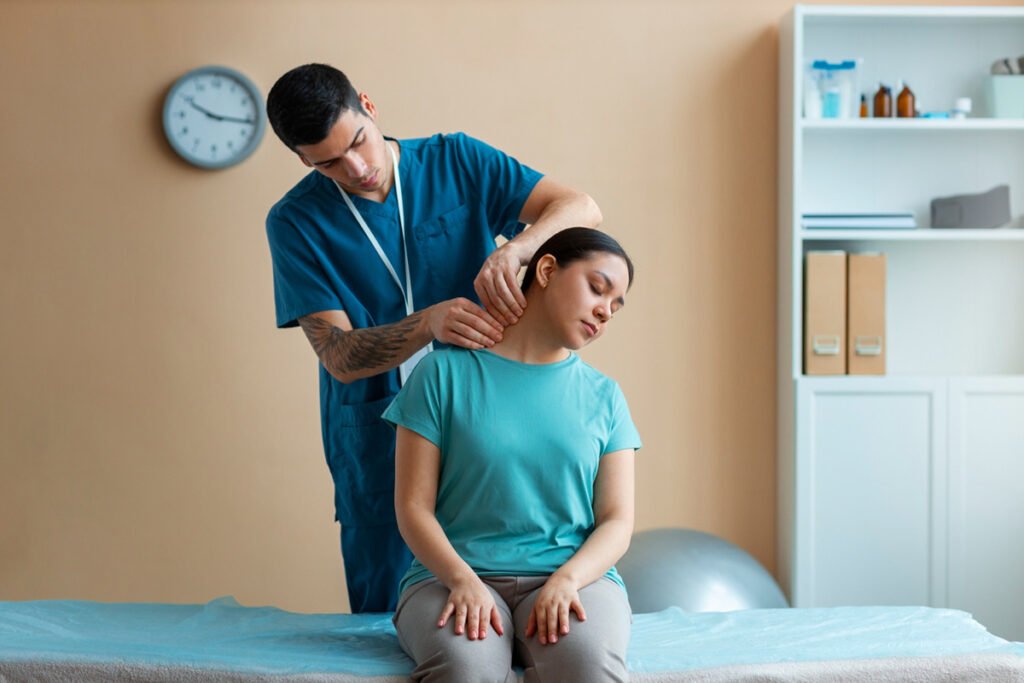
1. Cervical Range of Motion (ROM) Exercises
These exercises help reduce stiffness and maintain neck mobility.
a) Neck Flexion
- Sit or stand upright.
- Slowly bend your head forward, bringing chin towards chest.
- Hold for 5 seconds.
- Return to neutral.
- Repeat: 10 times
b) Neck Extension
- Slowly look upward towards the ceiling.
- Hold for 5 seconds.
- Return to neutral.
- Repeat: 10 times
c) Neck Side Bending
- Tilt your head towards the right shoulder.
- Do not raise the shoulder.
- Hold for 5 seconds.
- Repeat on left side.
- Repeat: 10 times each side
d) Neck Rotation
- Turn your head slowly to the right.
- Hold for 5 seconds.
- Repeat on left side.
- Repeat: 10 times each side
2. Isometric Neck Strengthening Exercises
These exercises strengthen neck muscles without movement, making them safe in early stages.
a) Neck Flexion Isometric
- Place palm on forehead.
- Try to bend head forward while resisting with hand.
- Hold for 5–7 seconds.
- Repeat: 10 times
b) Neck Extension Isometric
- Place hand behind head.
- Try to push head backward against resistance.
- Hold for 5–7 seconds.
- Repeat: 10 times
c) Side Flexion Isometric
- Place hand on right side of head.
- Try to tilt head sideways while resisting.
- Hold for 5–7 seconds.
- Repeat on left side.
- Repeat: 10 times each side
3. Deep Neck Flexor Strengthening
This exercise improves posture and reduces forward head posture.
Chin Tuck Exercise
- Sit or lie on your back.
- Pull chin backward (as if making a double chin).
- Keep eyes straight.
- Hold for 5–10 seconds.
- Relax.
- Repeat: 10–15 times
4. Shoulder and Scapular Strengthening Exercises
Strong shoulder and upper back muscles reduce stress on the neck.
a) Shoulder Shrugs
- Lift both shoulders upward.
- Hold for 5 seconds.
- Relax.
- Repeat: 10–15 times
b) Scapular Retraction
- Sit or stand straight.
- Pull shoulder blades backward and downward.
- Hold for 5–7 seconds.
- Repeat: 10–15 times
c) Wall Push-ups
- Stand facing a wall.
- Place hands on wall.
- Bend elbows and move body towards wall.
- Push back.
- Repeat: 10–15 times

Leave a Reply