
Best Treatment In Back Pain
1. INTRODUCTION TO BACK PAIN
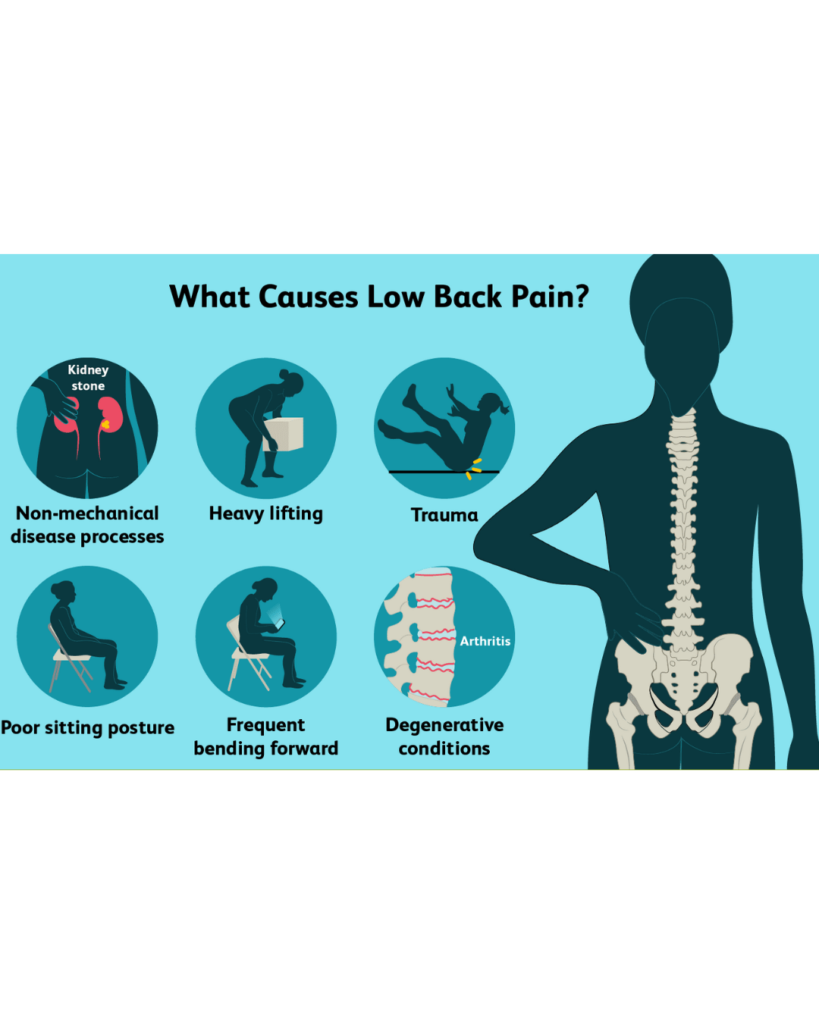
Back pain refers to discomfort, soreness, or pain located anywhere in the back region, from the neck to the pelvis. The back is a complex structure composed of vertebrae (bones), intervertebral discs, ligaments, joints, muscles, and nerves. Any disturbance or injury to these components can lead to pain. Although back pain may appear suddenly after lifting something heavy or awkward movement, it can also develop gradually due to poor posture, weak muscles, or degenerative changes.
Back pain is broadly divided into:
- Upper back pain
- Middle back pain
- Lower back pain (most common)
Lower back pain (lumbar region) is particularly common because the lumbar spine bears most of the body’s weight and is involved in bending, lifting, and twisting movements.
Back pain may be acute (less than 6 weeks), subacute (6–12 weeks), or chronic (more than 12 weeks). Chronic back pain usually indicates deeper structural or mechanical problems, muscle weakness, emotional stress, or lifestyle factors.
2. ANATOMY OF THE BACK
Understanding the back’s anatomy helps explain why pain occurs.
a) Spine Structure
The spine consists of:
- 33 vertebrae (cervical, thoracic, lumbar, sacral, coccygeal)
- Intervertebral discs that act as shock absorbers
- Facet joints for movement stability
- Ligaments connecting bones
- Muscles that support and move the spine
b) Intervertebral Discs
Each disc has:
- Nucleus pulposus (gel-like core)
- Annulus fibrosus (tough outer layer)
Disc degeneration or herniation is a common cause of back pain.
c) Muscles
Important muscle groups include:
- Erector spinae
- Multifidus
- Quadratus lumborum
- Gluteal muscles
- Abdominal muscles
Weakness or imbalance in these muscles often causes back pain.
d) Nerves
The spinal cord and nerve roots pass through the spine. Compression or irritation of nerves can cause radiating pain, numbness, or tingling.
3. CAUSES OF BACK PAIN
Back pain has multiple possible causes. Some of the most common include:
a) Muscle Strain or Ligament Sprain
Overstretching muscles or ligaments due to heavy lifting, sudden movements, or poor posture.
b) Herniated Disc / Slipped Disc
The disc’s inner gel protrudes, pressing on nearby nerves.
c) Degenerative Disc Disease
Age-related disc wear and tear causes chronic pain.
d) Spondylosis
Arthritis-like changes in the vertebrae and joints.
e) Spondylolisthesis
One vertebra slips forward over the one below it, causing pain and instability.
f) Sciatica
Compression of the sciatic nerve leads to lower back pain radiating to the leg.
g) Facet Joint Dysfunction
Inflammation or stiffness in facet joints.
h) Poor Posture
Long sitting hours, mobile use, driving, or computer work causing muscle imbalance.
i) Weak Core Muscles
Weak abdominal and back muscles increase spinal stress.
j) Trauma or Injury
Falls, road accidents, or sports injuries.
k) Osteoporosis
Weak bones may fracture easily, causing back pain.
l) Lifestyle Factors
- Obesity
- Lack of exercise
- Smoking
- Long sitting
- Stress
4. TYPES OF BACK PAIN
a) Mechanical Back Pain
Most common type. Caused by muscles, joints, and ligaments. Pain increases with activity.
b) Radicular Pain
Caused by nerve compression, e.g., sciatica.
c) Referred Pain
Pain felt in the back but originating from organs (kidney stones, abdominal issues).
d) Inflammatory Back Pain
Seen in conditions like Ankylosing Spondylitis.

1. OVERVIEW OF BACK PAIN PROGRESSION
Back pain usually begins suddenly, often due to an identifiable cause like lifting, twisting, sudden movement, or prolonged poor posture. Sometimes it develops gradually due to muscle weakening, disc degeneration, or poor ergonomics. If early care is taken, most acute back pain resolves in a few days to weeks. But if neglected, back pain can progress into a chronic condition affecting mobility, work, sleep, and mental health.
The progression typically follows this timeline:
- Acute Pain: 0–6 weeks
- Subacute Pain: 6–12 weeks
- Chronic Pain: More than 12 weeks
- Persistent Pain: Long-term recurring pain (months to years)
Each stage has distinct biological and psychological characteristics, which we will now study in a structured manner.
2. ACUTE STAGE OF BACK PAIN (0–6 Weeks)
The acute stage is the earliest phase and is characterized by sudden onset of symptoms. This stage typically lasts from a few days up to 6 weeks.
A) CAUSES OF ACUTE BACK PAIN
Common causes include:
- Muscle strain from lifting or bending
- Sudden twisting of the trunk
- Poor posture for long hours
- Minor disc irritation
- Facet joint locking
- Ligament sprain
- Sleeping on a soft or uneven surface
- Sudden jerk (in car or while slipping)
B) SYMPTOMS OF ACUTE STAGE
- Sharp, stabbing, or severe pain
- Difficulty bending or straightening the back
- Muscle spasm or tightness
- Local tenderness
- Pain increasing with movement
- Difficulty standing upright
- Pain radiating to buttocks (but usually not below the knee)
C) PHYSIOLOGICAL RESPONSE IN ACUTE STAGE
- Inflammatory phase begins.
The body reacts to injury by increasing blood flow and inflammatory chemicals, leading to swelling and pain. - Protective muscle spasm occurs.
The muscles tighten to protect the injured area from further damage. - Reduced mobility.
Pain limits movement as part of the natural healing process.
D) BEHAVIOR OF PAIN IN ACUTE STAGE
Pain is usually:
- Sharp
- Sudden
- Easily aggravated
- Relieved with rest
- Localized

Leave a Reply